.png)


How Asiatown Started: Houston's Gandhi District, Little Saigon, and Chinatown
- Austin Johnson

- Feb 5
- 16 min read
Updated: Feb 12
Houston's southwest side tells one of H-Town's most fascinating stories of immigration, displacement, and resilience. Along a ten-mile stretch from Hillcroft Ave through Bellaire Boulevard, these three distinct ethnic enclaves—the Mahatma Gandhi District, Chinatown, and Little Saigon—have created what some call "Asiatown," a vibrant commercial and cultural hub that serves over 600,000 Asian Americans in the Greater Houston area.
Yet these districts didn't emerge randomly or at the same time. Each represents a unique wave of immigration driven by specific historical circumstances, and their geographic alignment along this corridor reveals how economic opportunity, displacement, and community solidarity shape urban ethnic enclaves in Houston.
The Mahatma Gandhi District: Professional Migration and the Hillcroft Transformation
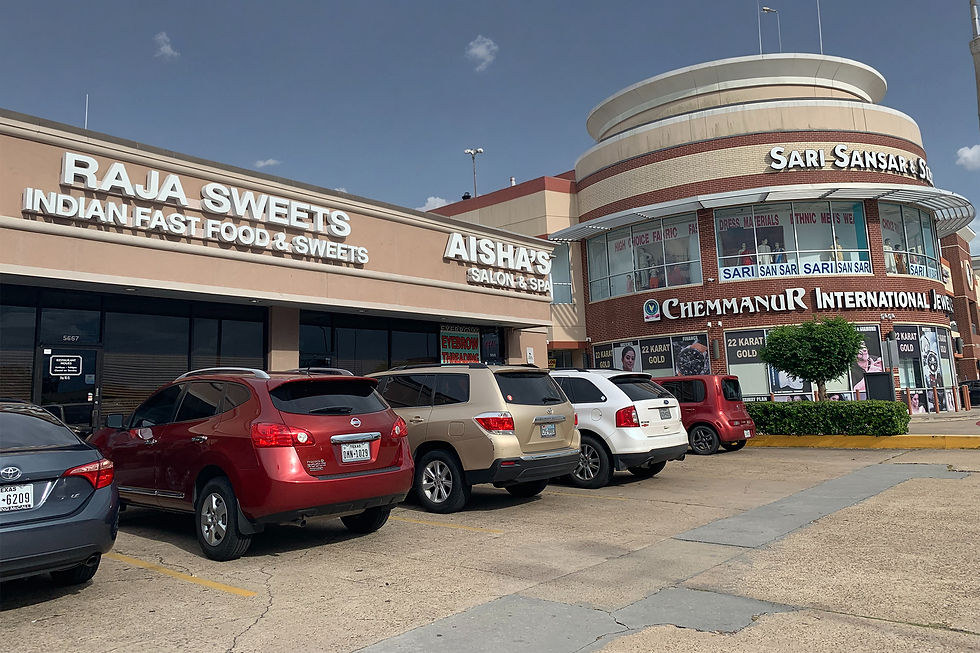
The Mahatma Gandhi District emerged in the early 1980s along Hillcroft Avenue when highly educated Indian and Pakistani professionals, drawn to Houston's booming energy sector, created a commercial enclave that would eventually serve over 100,000 South Asians. The district gained official recognition in 2010, becoming a milestone for a community that had grown from virtually nothing to one of Houston's most economically successful immigrant groups.
Indian and Pakistani immigration to Houston surged after the 1965 Immigration and Nationality Act, which prioritized skilled professionals, with many arriving in the 1960s-1970s as engineers, scientists, and medical professionals for Houston's expanding energy sector and medical institutions (per Rice University doctoral research by Uzma Quraishi)
The Hillcroft area was primarily undeveloped farmland in the early 1980s, containing only a fast food restaurant and auto shop before three pioneering South Asian families—the Lullas (Sari Sapne clothing), Patels (Karat 22 jewelry), and Gahunias (Raja Sweets)—opened businesses between 1983-1986 (per Wikipedia and APIAHiP)
Rupa Vyas moved Jay Stores grocery from Rice Village to Hillcroft in 1983, followed by Raja Sweets in 1985 (opened by Joginder "Yogi" Gahunia), establishing the commercial foundation that would attract dozens more South Asian businesses (per Wikipedia)

Joginder "Yogi" Gahunia and Family By 2010, the area was formally designated the "Mahatma Gandhi District" after seven years of advocacy by the India Culture Center, with Mayor Annise Parker and India's Consul General Sanjiv Arora announcing the designation on January 16, 2010 (per Wikipedia and Authentic Texas)
The district now serves an estimated 150,000 Indians and Pakistanis in Greater Houston (per APIAHiP 2025), with businesses thriving due to the community's high education and income levels—62-65% hold university degrees compared to 18-25% of the general population (per Houston Press 2011)
Sources: Wikipedia (Mahatma Gandhi District Houston), APIAHiP (2025), Rice University (Quraishi doctoral thesis), Houston Press (2011), Authentic Texas (2025)
Indian Americans predominantly settled in affluent western suburbs—particularly Sugar Land (37.5% Asian as of 2015),Clear Lake, Missouri City, Katy, and Pearland—rather than in the Gandhi District itself, using Hillcroft primarily as a commercial and cultural hub while residing in upscale residential areas. This settlement pattern differs fundamentally from Vietnamese and Chinese patterns, reflecting the professional-class nature of Indian immigration.
Fort Bend County, which includes Sugar Land and Missouri City, has Asian Americans comprising 23% of its 822,000 residents (182,000 people), with Indian Americans representing 37% of all Fort Bend Asians—the largest Asian subgroup in the county (per Houston Chronicle 2021, Rice Kinder Institute 2016)
Harris County Indian Americans numbered 46,125 in 2009, with median annual income of $53,000 in Harris County and $84,000 in Fort Bend County—significantly higher than county averages (per Wikipedia citing Houston Press)
Ramesh Cherivirala of India Culture Center explained in 2024: "Most Indians live very close by here—in Sugar Land, Pearland, and Clear Lake for NASA...everybody comes to this area because it is like a weekend go-town" (per Texas Highways 2024)
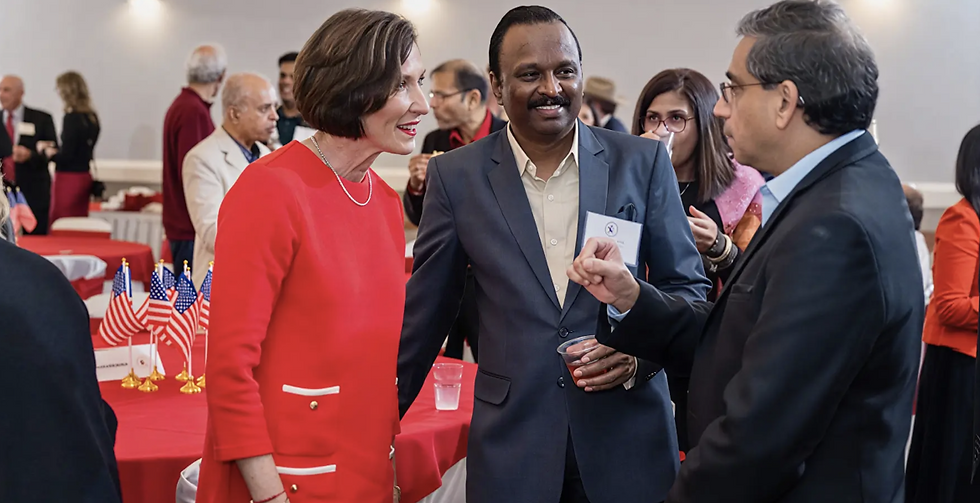
Ramesh Cherivirala in the middle The Gandhi District operates as a commercial enclave rather than residential neighborhood, with restaurants, grocery stores, jewelry shops, and sari stores serving a geographically dispersed community that drives in from surrounding suburbs (per Wikipedia)
Houston attracted Indian immigrants through oil and gas industry opportunities, with many arriving as petroleum engineers, geologists, and energy sector professionals during the 1970s-1980s boom, plus medical professionals for the Texas Medical Center (per Houston Chronicle 2024)
Sources: Houston Chronicle (2021), Rice University Kinder Institute (2016), Texas Highways (2024), Wikipedia (Asian Americans in Houston), Houston Press (2011)
Chinatown: Taiwanese Entrepreneurs

Houston's current Chinatown along Bellaire Boulevard emerged in 1983 when Taiwanese and Hong Kong developers, displaced from the gentrifying East Downtown "Old Chinatown," created a new automobile-centric commercial district that would grow to over six square miles. This "New Chinatown" was built deliberately by entrepreneurial immigrants during Houston's 1980s economic expansion, representing the third iteration of Chinatown in Houston's history.
The first Chinese immigrants to Houston were 250 men who arrived in 1870 to work on the Houston and Texas Central Railroad, with only seven Chinese residents counted in the 1880 census (per Wikipedia and Texas State Historical Association)
Houston's first Chinatown developed in the 1930s near Smith Street and Texas Avenue during the Great Depression; a second "Old Chinatown" emerged in the early 1950s in what is now East Downtown, growing significantly during the 1970s (per Houston History Magazine 2025)
The breakthrough came in 1983 when Kenneth Li and his uncle T.D. Wong opened Diho Plaza at Bellaire and Ranchester, the first Asian supermarket in the area, recruiting businesses from the West Coast and Taiwan to the "new world" being built (per Houston Chronicle 2023)

Kenneth Li aka (Mr. Chinatown) Chinese/Taiwanese immigration surged after the 1965 Immigration Act, with Houston's Chinese population growing from about 325 in 1960 to 2,500 by the late 1960s, reaching 30,000 by 1983 and 43,940 in Harris County by 2010 (15.7% of county Asians) (per Wikipedia)
By 2013, Greater Houston had 72,320 residents of Chinese origin, with the community split between Mainland Chinese, Taiwanese, and Hong Kong immigrants who often maintained separate community organizations due to political differences (per Wikipedia and Texas Observer 2024)
Sources: Wikipedia (History of Chinese Americans in Houston, Chinatown Houston), Texas State Historical Association, Houston Chronicle (2023, 2024), Houston History Magazine (2025), Texas Observer (2024)
Chinese Americans followed a suburban dispersal pattern similar to Indians, settling predominantly in Sugar Land, Katy, Cypress, and The Woodlands rather than near Chinatown itself. The shift from Old Chinatown to Bellaire was driven by gentrification, highway construction, and the community's economic mobility into middle-class suburbs, making the new Chinatown primarily a commercial rather than residential district.
Chinese businesses concentrate inside Beltway 8 along Bellaire Boulevard, while Vietnamese businesses dominate west of Beltway 8—creating a clear geographic division along the same corridor (per Wikipedia and Greater Houston Convention and Visitors Bureau)
Sugar Land's Asian population reached 37.5% by 2015, with Chinese Americans comprising 21% of Fort Bend County's Asian population (second-largest group after Indians) (per Rice Kinder Institute 2016)
The Katy area experienced 300% growth in Asian population from 2000-2010, reaching approximately 40,000 by 2019, prompting development of Katy Asian Town in 2017-2018 with an H-Mart solidifying the community (per Houston Chronicle 2018)
Taiwanese immigrants arrived in the 1970s-1980s seeking freedom from the Kuomintang's authoritarian regime, with many initially coming as university students who stayed after graduation for Houston's energy sector opportunities (per Texas Observer 2024)
Old Chinatown's displacement occurred in the 1990s as developers targeted East Downtown for high-rise construction—"You're a single-story mom-and-pop business and they're trying to build something 20 stories tall right there. How can you compete with that?" recalled business owner quoted in Houston Chronicle (2022)
Sources: Wikipedia (Chinatown Houston), Greater Houston Convention and Visitors Bureau, Rice University Kinder Institute (2016), Houston Chronicle (2018, 2022, 2023), Texas Observer (2024)
The Taiwanese Difference: Entrepreneurial Pioneers of New Chinatown
Taiwanese immigrants were the primary architects of Houston's "New Chinatown" on Bellaire Boulevard, deliberately replicating the success model of Monterey Park, California. Unlike earlier Cantonese laborers or later Mainland Chinese immigrants, Taiwanese arrivals in the 1970s-1980s were predominantly educated professionals and entrepreneurs who transformed Houston's Chinese community from working-class to middle-class, bringing capital, business acumen, and political activism that fundamentally shaped the district's character.
Taiwanese immigrants specifically pioneered the shopping center development model that created Bellaire Chinatown in the mid-1980s, consciously attempting to "duplicate the Taiwanese success of Monterey Park" in Houston (per Wikipedia on Taiwanese Americans)
The Taiwanese arrival wave differed fundamentally from historical patterns: pre-1950s Houston Chinese were Cantonese laborers "often not formally educated," while Taiwanese immigrants after 1965 were urban, educated professionals fleeing political oppression under the Kuomintang dictatorship (per Wikipedia and Texas Observer 2024)
In the 1970s-1980s, Taiwanese migrants including "many of my relatives, settled in Houston seeking freedom from the Kuomintang's oppressive regime...In their 20s, they formed student associations at the University of Texas, Texas A&M University" before transitioning into Houston's energy sector (per Texas Observer 2024)
Kenneth Wu, a Taiwanese immigrant who arrived in 1980 after studying in New Mexico and working in New York, came to Houston specifically "for the humid climate and growing Taiwanese immigrant community" that was just beginning to develop the new Asiatown on Bellaire Boulevard (per Houston Chronicle 2024)
By the 1980s-1990s, over half of Global One Bank's customers were local Taiwanese-owned businesses, though this has declined to 5-10% as second-generation Taiwanese became doctors and lawyers rather than restaurant owners (per Houston Chronicle 2023)
Sources: Wikipedia (Taiwanese Americans, History of Chinese Americans in Houston), Texas Observer (2024), Houston Chronicle (2023, 2024)
Taiwanese maintained separate political and cultural identity from Mainland Chinese immigrants, establishing the Taiwanese Community Center in 1992 as an explicit alternative to the Chinese Community Center, which they viewed as representing Mainland interests. This political separation reflected deep divisions rooted in Taiwan's authoritarian history and the independence movement, making Houston's "Chinatown" actually a contested space between distinct Chinese-speaking communities.
The Taiwanese Community Center (TCC) opened in 1992 in Bellaire Chinatown, founded by Taiwanese immigrants led by Dr. Yu Yan-Lee "who pooled their resources to have a community center independent from the CCC, which is believed to solely represent the interests of Mainland Chinese" (per Wikipedia)
The TCC became a stronghold of the pro-Taiwanese Independence movement, with its political arm—the Taiwanese Heritage Society of Houston—hosting political figures including Texas State Representative Hubert Vo and Taiwan's President Tsai Ing-Wen (per Wikipedia)
China Airlines, citing "many Taiwanese companies had offices in Houston," launched the first Asian carrier service to Houston in 2004 with direct Taipei flights, even operating private bus service to Sugar Land and Southwest Houston Chinatown until service ended in 2008 (per Wikipedia)
The political division remains visible in Houston's Chinese community structure: while Taiwanese used the Taiwanese American Association for organizing, Mainland immigrants increasingly use WeChat (as of 2020), and the communities maintain parallel cultural institutions (per Wikipedia)
Despite political separation, Taiwanese immigrants integrated economically similar to other Chinese groups—dispersing to affluent suburbs like Sugar Land while using Bellaire primarily as a commercial hub, following the professional-class mobility pattern rather than creating residential enclaves (per multiple sources)
Sources: Wikipedia (History of Chinese Americans in Houston, Taiwanese Americans), Houston Chronicle (2023, 2024)
The 1997 Handover Exodus: Hong Kong's Pre-Emigration Wave
Hong Kong Chinese immigration to Houston occurred primarily during a specific 13-year window (1984-1997) driven by panic over Communist Chinese takeover, creating an exodus of middle-class professionals and business owners who brought British colonial business practices to Texas but often maintained plans to return—fundamentally different from Taiwanese immigrants who fled permanently from political persecution.
On December 19, 1984, the People's Republic of China and United Kingdom signed the Sino-British Joint Declaration announcing Hong Kong's July 1, 1997 handover to China, triggering immediate emigration panic—from 1984 to 1997, approximately 1 million Hong Kong residents emigrated, creating what scholars called a "brain drain" of educated professionals and capital flight (per Wikipedia on Handover of Hong Kong, multiple academic sources)
The 1989 Tiananmen Square massacre in Beijing accelerated Hong Kong's emigration panic, as the brutal crackdown confirmed fears that Communist China would not respect freedoms or human rights—many who had delayed leaving immediately sought foreign passports and residency (per EBSCO Research Starters, academic migration studies)
Canada (Vancouver, Toronto), United States (San Francisco, Los Angeles, New York), and Australia (Sydney, Melbourne, Perth) were the most popular destinations—Houston was a secondary US destination behind California cities but still attracted thousands of Hong Kong immigrants drawn by energy sector opportunities, affordable housing, and lack of zoning for easy business development (per Wikipedia, Migration Policy Institute 2024)
The UK refused to grant British citizenship to most Hong Kong residents despite 150 years of colonial rule, offering only British National (Overseas) passports that allowed visa-free travel but no residency rights—forcing Hong Kong emigrants to make their own arrangements in North America and Australia (per EBSCO Research Starters, Hong Kong handover documentation)
Unlike Taiwanese who arrived as permanent immigrants fleeing dictatorship, many Hong Kong emigrants maintained "astronaut families"—husbands working in Hong Kong while wives and children lived abroad to secure foreign citizenship, with plans to potentially return if the handover went smoothly (per academic research on Hong Kong transnational migration)
Statistics show 35% of Hong Kong emigrants from the 1980s-1990s ultimately returned to Hong Kong after 1997 when immediate fears of Communist crackdown did not materialize—this "returning tide" pattern was unique to Hong Kong immigrants and did not occur with Taiwanese (per academic migration studies)
Sources: Wikipedia (Handover of Hong Kong, Emigration from Hong Kong), EBSCO Research Starters, Migration Policy Institute (2024), academic journals on Hong Kong migration patterns

Hong Kong City Mall: The Ethnic Chinese Developer from Vietnam
The single most important development in Houston's Chinatown—the 400,000-square-foot Hong Kong City Mall that opened in 1999—was built by an ethnic Chinese (Hoa) immigrant raised in Vietnam, illustrating the complex overlapping identities within Houston's supposed "Chinatown" and revealing how ethnic Chinese from Southeast Asia often identified with Hong Kong Cantonese culture rather than Mainland or Taiwanese Chinese communities.
Hai Du Duong, developer of Hong Kong City Mall, was "an ethnic Chinese raised in Vietnam" who fled as a refugee and became a major Houston real estate developer—he was part of the Hoa people, ethnic Chinese who had lived in Vietnam for generations but maintained Chinese language and culture (per Houston Chronicle 2005, 2022)
Duong purchased 25.5 acres on Bellaire Boulevard west of Beltway 8 at reportedly $1 per square foot in the mid-1990s and secured a $16 million construction loan—Metro Bank could only loan $5 million, so bank president helped Duong secure additional loans from banks in other cities and Taiwan to complete the project (per China Daily 2015)
Hong Kong City Mall opened in fall 1999 with "the gigantic Hong Kong Food Market, a two-story banquet hall restaurant, a lotus pond and over 100 retail stores, cafes, restaurants and services, most of which are connected to each other indoors"—at 400,000 square feet it became one of Houston's largest Asian shopping centers (per China Daily 2015, Houston Chronicle 2022)
The mall's name "Hong Kong City Mall" explicitly referenced Hong Kong identity, not Vietnamese or Taiwanese, yet it was developed by an ethnic Chinese who fled Vietnam—illustrating how Hoa people from Southeast Asia often aligned culturally with Cantonese/Hong Kong Chinese rather than Vietnamese identity despite their Vietnamese nationality (per multiple sources)
Hong Kong City Mall became the anchor that triggered massive Vietnamese business migration west of Beltway 8, creating today's geographic division: Chinese businesses dominate inside Beltway 8 while Vietnamese businesses dominate west of Beltway 8—thus a Hong Kong Chinese developer from Vietnam literally created the boundary between Chinatown and Little Saigon (per Houston Chronicle 2022, Wikipedia)
"Though showing some of its 34 years of age today, the green-roofed building, designed in the traditional eastern style, is still very much in business, complete with a traditional supermarket, food court, Vietnamese record store, and even an Asian beef and seafood jerky specialist" (per Houston Chronicle 2022)
Sources: Houston Chronicle (2005, 2022), China Daily (2015), Wikipedia (Little Saigon Houston, Chinatown Houston)
Ethnic Chinese from Vietnam (Hoa People): The Hidden Bridge Community
A significant subset of Houston's "Hong Kong Chinese" were actually ethnic Chinese (Hoa) who had lived in Vietnam for generations, spoke Cantonese, and fled as refugees in the late 1970s-1980s following Communist persecution—these Vietnamese-Chinese immigrants bridged the Vietnamese and Chinese communities, often identifying more with Hong Kong Cantonese culture than with either Vietnamese or Mainland Chinese identity.
Vican Tan, owner of Viet Hoa supermarket chain (opened 1984 at Wilcrest and Beechnut as one of southwest Houston's first Asian supermarkets), was "an ethnic Chinese raised in Vietnam" who fled at age 16 with a passport his parents bought for foreign study, escaped to Paris where he worked as dishwasher and busboy while studying electrical technology, then reunited with his parents and five sisters in Houston in 1982 (per Houston Chronicle 2005)
Tri La, owner of the Kim Son restaurant chain (Houston landmark since 1980), was ethnic Chinese from Vietnam who brought Vietnamese-Chinese fusion cuisine to Houston—Kim Son became famous for its "Mama La" matriarch who "memorized over 250 family recipes before fleeing Vietnam and ending up in Houston in 1980" (per Houstonia Magazine 2025)
These Vietnamese-Chinese (Hoa) immigrants spoke Cantonese, maintained Chinese cultural practices and cuisine, but held Vietnamese nationality—they often operated businesses serving both Vietnamese and Chinese customers, creating commercial partnerships across ethnic lines that pure Vietnamese or Chinese entrepreneurs could not (per Houston Chronicle 2005)
Historical context: Hundreds of thousands of ethnic Chinese fled Vietnam in the late 1970s-1980s as "boat people" following the Communist government's persecution and nationalization of the Chinese merchant class—many ethnic Chinese Vietnamese were second-wave refugees (1978-1982) who fled by sea, with thousands dying in the dangerous journey (per Wikipedia on Vietnamese Americans)
In 1990, Vietnamese median household income in Harris County was $22,284 compared to $39,318 for Chinese in Fort Bend County—but ethnic Chinese (Hoa) from Vietnam often had higher incomes than pure Vietnamese refugees due to their historical merchant class background and business acumen (per Wikipedia citing census data)
Diho Square's founding partners included entrepreneurs "from Hong Kong, Taiwan, Japan, Indonesia, and Malaysia"—indicating the pan-Asian ethnic Chinese diaspora nature of Bellaire Boulevard's development, not just Hong Kong or Taiwan specifically (per D-Square/Diho website about us page)
Sources: Houston Chronicle (2005), Houstonia Magazine (2025), Wikipedia (History of Vietnamese Americans in Houston), D-Square/Diho Square about page
Little Saigon: Refugee Resettlement and the Bellaire Expansion

Little Saigon developed west of Beltway 8 along Bellaire Boulevard in the 1990s-2000s after Vietnamese refugees, who had initially settled in Midtown's original "Little Saigon" in the late 1970s, were displaced by gentrification and rising rents. Houston's Vietnamese community, now numbering 143,000-157,000, represents the second-largest Vietnamese population in America after Los Angeles, built primarily by three waves of post-war refugees.
The Fall of Saigon on April 30, 1975 triggered the first wave of Vietnamese refugees, with approximately 130,000 fleeing immediately—many highly educated with US military ties (per Wikipedia and Houston Chronicle 2025)
Houston became a major resettlement destination due to its warm climate (similar to Vietnam), affordable housing, church-sponsored refugee programs, and economic opportunities in shrimping and manufacturing (per PBS NewsHour 1998, Wikipedia)
The second wave (1978-1982) consisted of "boat people"—over a million refugees who fled by sea, many ethnic Chinese Vietnamese, with thousands dying in the dangerous journey; the third wave (1980s-1990s) included political prisoners and family reunifications (per Wikipedia)
By December 1991, over 60,000 Vietnamese resided in Houston; by 2010, Harris County had 80,409 ethnic Vietnamese (28.7% of county Asians); by 2019, the metro area reached 143,000 (per Wikipedia, Pew Research Center 2019)
The original Midtown Little Saigon (1980s-2000s) stretched from Highway 59 South to West Gray Street, with the street temporarily renamed Hai Bà Trưng after Vietnamese warrior sisters, but gentrification and rising property taxes forced businesses to relocate southwest (per Houston Chronicle 2022, ABC13 2022)
Sources: Wikipedia (History of Vietnamese Americans in Houston, Little Saigon Houston), Pew Research Center (2019), Houston Chronicle (2022, 2025), ABC13 Houston (2022), PBS NewsHour (1998)
Vietnamese Americans created true residential enclaves in southwest Houston, living in clustered "village" apartment complexes near their businesses—a fundamentally different pattern from the suburban dispersal of Chinese and Indian communities. This working-class, community-focused settlement pattern reflects their refugee origins and the mutual support networks essential for survival after displacement.
Vietnamese settlement concentrated in specific "village" complexes including St. Joseph Village, Saigon Village, Thai Xuan Village, Hue Village, Thanh Tam Village, Da Lat Village, and St. Mary Village throughout southwest, northwest, and southeast Houston (per ABC13 2022)
In 1990, Vietnamese median household income in Harris County was $22,284 with 18% holding bachelor's degrees, compared to Chinese median income of $39,318 in Fort Bend County—reflecting the working-class nature of refugee resettlement versus professional immigration (per Wikipedia)
Hong Kong City Mall, opened in 1999 by Vietnamese entrepreneur Hai Du Duong, became the anchor that spurred massive Vietnamese business growth west of Beltway 8, creating today's Little Saigon (per Wikipedia and Houston Chronicle 2023)
In 2015, the portion of Bellaire Boulevard between Beltway 8 and Eldridge Parkway was officially designated "Saigon Boulevard" (Đại Lộ Sài Gòn) with Vietnamese street names and bilingual signs, though a 2016 proposal to create an official "Little Saigon District" was rejected by Alief area residents (per Wikipedia)
Vietnamese businesses prospered through community-focused enterprises: "If you drive along Bellaire, you'll see a lot of Vietnamese businesses that are flourishing, and that contributes a lot to Houston," explained community leader (per Houston Chronicle 2025)
Sources: Wikipedia (Little Saigon Houston, History of Vietnamese Americans in Houston), ABC13 Houston (2022), Houston Chronicle (2023, 2025)
Why They Clustered: The Bellaire Boulevard Convergence
The geographic proximity of these three distinct ethnic enclaves along the Bellaire-Hillcroft corridor was not coincidental but rather the result of Houston's unique combination of cheap land, lack of zoning, the 1980s oil bust creating commercial vacancies, and a pattern where each community's displacement created opportunities for the next. The clustering reflected both economic pragmatism and the demonstrated viability of ethnic commercial districts in southwest Houston.
The 1980s oil glut devastated Houston's economy, leaving abundant cheap commercial real estate in the Sharpstown/Alief area that made strip mall development financially viable for immigrant entrepreneurs (per Wikipedia and Houston Chronicle 2022)
Houston's lack of zoning laws and business-friendly permitting made it "relatively cheap to start a small business in this part of town," enabling rapid ethnic enclave development without regulatory barriers faced in other cities (per Houstonia Magazine 2023)
The Alief area already had substantial Asian residential population by the early 1980s, creating a customer base that justified commercial development—Asian families had moved to these "then-suburbs of Bellaire, Sharpstown, and Spring Branch" for affordable housing (per Houstonia Magazine 2024)
Each district's success validated the model for the next: Chinatown's 1983 emergence proved commercial viability, which encouraged Vietnamese businesses displaced from Midtown in the 1990s to relocate adjacent (west of Beltway 8), and demonstrated to Indian entrepreneurs that Hillcroft (3 miles north) could support ethnic retail (per Houston History Magazine 2025)
Land values along Bellaire Boulevard increased 25-50% between 2004-2008, with the Asian American Business Council estimating 2 million square feet of new construction, reflecting the district's tremendous success (per Wikipedia)
Sources: Wikipedia (Chinatown Houston, Little Saigon Houston), Houston Chronicle (2022, 2023), Houstonia Magazine (2023, 2024), Houston History Magazine (2025)
The three districts have maintained distinct identities despite physical proximity, with minimal overlap in business ownership or residential patterns. Chinese businesses dominate inside Beltway 8, Vietnamese businesses outside it, and the Gandhi District operates as a separate South Asian hub, creating what locals call "Asiatown"—a multicultural corridor where communities coexist rather than integrate.
The Greater Houston Convention and Visitors Bureau formally recognizes the combined area as "Asiatown," acknowledging it consists of distinct Chinatown and Little Saigon neighborhoods that together form a 6+ square mile commercial district (per Wikipedia)
Debate over naming reflects identity tensions: "Is it really a Chinatown? If it's majority Vietnamese folks living there, how would they be able to start calling it Chinatown?" questioned diversity professional Nick Lee (per Houstonia Magazine 2025)
By 2025, the three communities show different integration patterns: Vietnamese maintain strong ethnic business concentration and residential clustering; Chinese have dispersed to suburbs while maintaining commercial presence; Indians use Gandhi District purely as commercial hub while living in distant affluent suburbs (per multiple sources)
Harris County's Asian population grew 38% from 2010-2020 to 392,000 (8% of county), while Fort Bend County reached 23% Asian (182,000 people, 83.7% growth)—with all three communities contributing to making Houston the fifth-largest Asian American metro area in the US (per Houston Chronicle 2021, US Census 2020)
The corridor's evolution continues: Katy Asian Town opened 2017-2018, representing westward expansion as second-generation Asian Americans seek suburban amenities while maintaining cultural connections (per Houston Chronicle 2018, 2023)
Sources: Wikipedia (Chinatown Houston), Greater Houston Convention and Visitors Bureau, Houstonia Magazine (2025), Houston Chronicle (2018, 2021, 2023), US Census Bureau (2020)
The story of Houston's Gandhi District, Chinatown, and Little Saigon reveals how immigration policy, economic opportunity, and urban development patterns create ethnic enclaves. The 1965 Immigration Act opened Asian immigration; the Vietnam War created refugees; Houston's energy boom drew professionals; gentrification displaced communities; and cheap southwest Houston land provided space for rebuilding. Today, over half a million Asian Americans call Greater Houston home, with the Bellaire-Hillcroft corridor standing as testament to how distinct communities can flourish side-by-side, each maintaining unique identity while collectively transforming Houston into one of America's most diverse metropolitan areas.
Hope you learned something new about our incredible city, Peace. Until next time.


Comments