.png)


Exploring Cultural Immersion in Houston's Little Saigon — And What I've Learned
- Austin Johnson

- May 4
- 7 min read
I didn't walk into Little Saigon trying to learn about Vietnamese culture. I walked in because I was building something — Plan Your Day Houston — and I needed to understand the places I was putting into the database. But what happened over the months that followed taught me more about cultural immersion than any research ever could.
I'm a Black man from Houston. I've lived here most of my life. And until I started spending real time in Little Saigon, I had no idea how much of my own city I'd never seen.
This is what I've learned about entering a space that wasn't built for you — and what actually gets you through the door.

The Walls Are Real — And They Exist for a Reason
I need to be honest about this. The first time I walked into a Vietnamese space in Little Saigon, nobody looked at me. Not in a hostile way — more like I didn't register. People moved around me, went about their business, avoided eye contact. I wasn't unwelcome. I just wasn't relevant. I was passing through their world, and they had no reason to believe I'd be back.
That guardedness isn't random. It was built over 50 years.
When the first Vietnamese refugees arrived in Houston after the Fall of Saigon in 1975, they were placed in low-income neighborhoods with almost no support. Public opinion at the time ran 10-to-1 against accepting them. Many experienced robberies, violence, and outright hostility from their new neighbors. The KKK targeted Vietnamese fishermen in Galveston Bay in 1981. A Vietnamese journalist was murdered in Houston in 1982 for his reporting.
They built Little Saigon — the businesses, the temples, the plazas, the grocery stores — as a self-contained ecosystem. Everything runs in Vietnamese. The menus, the signage, the conversations. That's not a barrier to entry. That's intentional architecture. They built a world that functions without needing anyone outside of it, because for a long time, the outside wasn't safe.
Understanding that history changes how you walk into these spaces. You're not being ignored. You're entering a community that learned to survive by keeping to itself. The question isn't why they don't welcome you with open arms. The question is whether you have the patience to earn your place.
The Younger Generation Isn't Impressed
If you think showing up with cultural curiosity is going to get you anywhere with American-Born Vietnamese think again. They grew up code-switching between their parents' world and American culture. They've been the "exotic" friend. They've been asked to explain their food, their customs, their family. They're over it, and it shows.
They don't care that you appreciate Vietnamese culture. That's not a currency that buys anything in their world. They've seen plenty of non-Vietnamese people show up for pho, post about it, and disappear. Your fascination with their heritage is not the bridge you think it is.
The older generation — 30 and up, especially the elders — is different. Not warmer exactly, but more observant. They watch. They notice who keeps coming back and who was just passing through. They don't respond to smiling. They don't respond to enthusiasm. They respond to something much harder to fake: authenticity.
My Experience at Chez Beignet
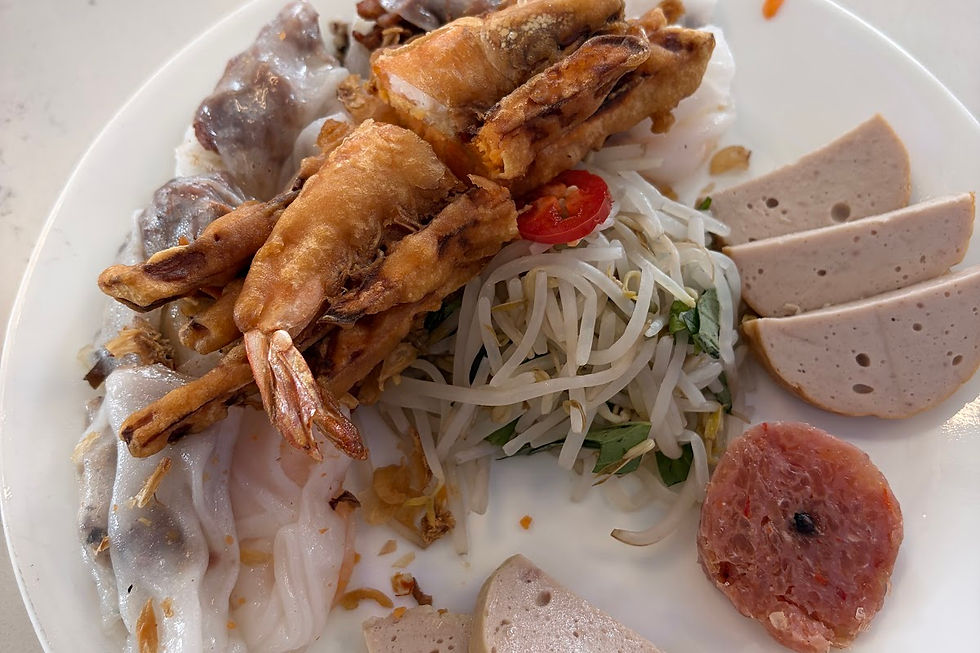
I went to Chez Beignet Cafe one evening. Ordered a coffee — black, with little pillows beignets of condensed milk — and sat in the back with my laptop. I wasn't trying to be seen,disrupt or make their everyday patrons uncomfortable, neither was I performing cultural curiosity, but more so enjoying its escapism all to myself.
Karaoke started around 7pm on Friday. A group of older Vietnamese women — aunties — were singing. Vietnamese ballads, some English classics. But the music was good. And I started humming along and clapping for everyone's performances as I was enjoying the different vocal variations and different collections of instruments.
They noticed.
One of the aunties came over and asked me to join the queue. I didn't expect it. I looked through my phone full of songs I could not possibly sing or rap to, got desperate, and asked Claude to find me a song. Fly Me to the Moon made the most sense, so I sang it.
What happened next still catches me off guard when I think about it. They have roses — actual roses — that they give you when they love your song. People got up from their tables and brought me roses. They told me I did great. These women who hadn't made eye contact with me an hour earlier were now handing me flowers and treating me like I'd been coming there for years.
I've done public singing before — at Friendship BBQ, for peers, at other spots around Houston. I'm comfortable with it. But I never expected that kind of warmth from a room I'd walked into as a complete outsider.
What I realized afterward is that they weren't rewarding my singing. They were rewarding my courage. I was a Black man in the back of a Vietnamese karaoke cafe, singing along to their music without being asked, not performing for attention, just vibing. When they handed me the mic, it was because they saw something real — not cultural tourism, not someone checking a box, just a person who was genuinely feeling the music in their space.
That's what I mean when I say common ground is what leads you toward cultural immersion — not a fascination with the culture itself.
Learning the Language, One Drink at a Time

I've been going to Kravin Fruit Bar for boba. It's become a regular spot. But what's shifted the dynamic isn't the frequency of my visits — it's the small effort I've put into learning Vietnamese.
I've been studying pronunciation. Meticulously. Vietnamese is tonal — the same word said with a different inflection means something completely different. It's humbling. I have experience with Chinese, I've lived there on and off for over 7 years, but I've lately switched over to Vietnamese, and one day at Kravin I saw a drink on the menu I wanted to try: Suong Sa Hot E.
I ordered it. And then I asked if I said it right.
The woman behind the counter didn't just say yes or no. She stopped what she was doing, smiled, and taught me how to pronounce the "E" correctly. She wasn't annoyed. She wasn't performing patience. She was genuinely pleased that someone had made the effort — even a small one — to meet her language where it lives.
That's a tiny moment. But tiny moments are what immersion is actually made of. I didn't walk in with a Vietnamese phrasebook and start reciting sentences at people. I learned one drink name, tried to say it correctly, and asked for help when I wasn't sure. Light curiosity. Not a performance.
What Doesn't Work
Let me save you some time.
Walking into a Vietnamese grocery store and asking someone how to cook something they're buying — that's annoying. They're grocery shopping, not running a cultural exchange booth. They don't owe you a cooking lesson because you're curious about lemongrass.
Sitting in a Vietnamese coffee shop and trying to strike up conversations with the table next to you — that's not how coffee shops work in any culture. People are there for their own moment, their own conversation, their own quiet. It's a private space, not a social one.
Smiling at everyone and expecting warmth back — that doesn't land. The Vietnamese community in Houston isn't cold, but they're not performatively friendly with strangers either. Excessive friendliness from someone they don't know reads as suspicious, not charming.
Showing up once, eating pho, and calling it cultural immersion — that's tourism. The community has seen a thousand of you. You came for the food. You left. You didn't change anything about how you see the world, and they didn't learn your name.
What Actually Works
Context. Respect. Light curiosity. And middle ground.
Context means understanding what you're walking into. This is a refugee community that built its own world from nothing in a city that didn't want them here. Every Vietnamese space you enter in Houston carries that history, whether it's visible or not. You don't need to recite it. You just need to move through these spaces with the awareness that they weren't built for your comfort.
Respect means staying out of the way until you're invited in. Sit in the back. Order something. Be present without demanding attention. Don't assume your curiosity entitles you to anyone's time or energy.
Light curiosity means making small efforts that signal you're paying attention — learning a word, trying to pronounce a menu item, coming back to the same spot more than once. Not a deep dive. Not a crash course. Just enough to show you're not passing through.
And middle ground is the real key. The moment at Chez Beignet didn't happen because I was fascinated by Vietnamese culture. It happened because I was singing. Music is universal. The aunties didn't see a cultural tourist — they saw someone feeling the same songs they were feeling. That shared moment, that common ground, is what opened the door. Not my knowledge of their history. Not my appreciation of their food. A song.

What Immersion Actually Looks Like
It's not a day trip. It's not a checklist. It's showing up to the same places over time, being a familiar face before you're a friend, and letting the relationship develop at the community's pace — not yours.
It's ordering the same drink at Kravin until the person behind the counter recognizes you. It's going to Chez Beignet on a Saturday night and sitting in the back until someone remembers you from last time. It's walking through Saigon Plaza on a Sunday and not needing anyone to acknowledge you, just existing in the space and letting it be enough.
The Vietnamese community in Houston has been here for 50 years.
They've built something extraordinary — a living culture that preserved everything they carried across the ocean. Temples, food traditions, coffee rituals, community rhythms that mirror what their grandparents practiced in Saigon and Hanoi and the Mekong Delta.
None of it was built for you. All of it is accessible to you — if you show up the right way.
Light curiosity. Context. Respect. And the willingness to find common ground instead of demanding access.
That's cultural immersion. Not reading about it. Living it. One visit, one drink, one song at a time.
Plan Your Day Houston maps Vietnamese cultural immersion in Houston — 96 places across temples, cafes, restaurants, grocery stores, and community spaces. Your first day plan is free.


Comments